TOUS LES ARTISTES DEVRAIENT AVOIR DES œUVRES GRATUITES, pour que l'art reste ACCESSIBLE à TOUS, fasse partiE de la vie ordinaire et ne soit pas uniquement réservé à un public de happy few.
Christine Demias
Dans son “Essai sur le don”, l' anthropologue Marcel Mauss démontre que le don est articulé dans une triple obligation : "donner, recevoir, rendre”.
Il construit ainsi une forme de contrat social basé sur la réciprocité qui induit une dépendance. Cette dépendance autorise la recréation permanente du lien social. Il en déduit que les phénomènes économiques ne sont pas dissociables des autres aspects de la vie sociale et ne peuvent se réduire à de purs calculs d'intérêts.
Il construit ainsi une forme de contrat social basé sur la réciprocité qui induit une dépendance. Cette dépendance autorise la recréation permanente du lien social. Il en déduit que les phénomènes économiques ne sont pas dissociables des autres aspects de la vie sociale et ne peuvent se réduire à de purs calculs d'intérêts.
A4xX est une œuvre en forme de collection, une édition illimité gratuite qui tente d' expérimenter d'autres relations sociales autour de l'art.
Moins la fabrication de l’œuvre est coûteuse, plus l’économique perd de son pouvoir. Or nous dévalorisons, sans nous en rendre compte, ce qui est gratuit. Ce qui ne coûte rien ne compte pour rien.
- Changer de paradigme en permettant l’accès de tous à la création artistique, en créant des conditions de relations, d’échanges, de rencontres, en favorisant des circulations, des réseaux.
- Expérimenter dans et en dehors des circuits officiels, plus fermés que jamais depuis qu’y dominent le vedettariat et la financiarisation de l’art.
- Résister à la spectacularisation de l’art et à l’emphase de l’objet.
- Déjouer l’emprise des structures hyper sélectives de l’art dominant.
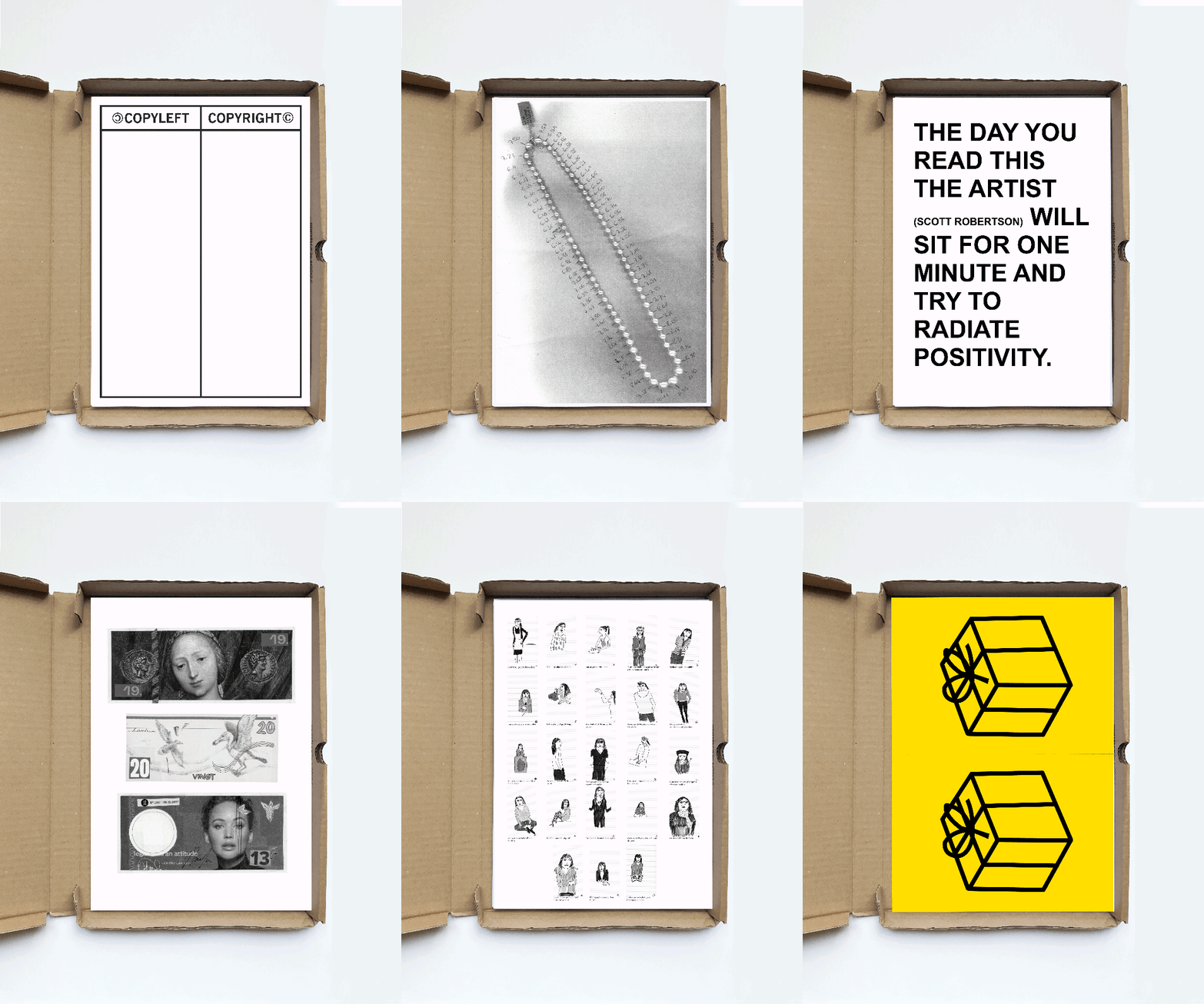
Voilà l’ambition de A4xX, une œuvre collective et participative, une œuvre mobile, une forme artistique active par laquelle des artistes, critiques, écrivains, philosophes, poètes, designer, architectes, graphistes… (en respectant la parité homme/femme) conçoivent des propositions plastiques sur le thème de “l’art sans l’argent”, ou ce qu'ils veulent, sous formes de feuillet mobile. Les œuvre en noir et blanc, au format A4 sont photocopiés et mis à disposition du public lors de présentations/ activations.
Une boite est mise à disposition du public gratuitement pour conserver les feuilles.
Les présentations se feront dans des lieux pas forcement dédiés à l’art, et parfois conditionnés par la présence du photocopieur.
ALL ARTISTS SHOULD HAVE FREE WORKS, SO THAT ART REMAINS ACCESSIBLE TO ALL, IS MORE A PART OF LIFE AND IS NOT JUST RESERVED FOR A HAPPY FEW.
Christine Demias
Christine Demias
In his “Essays on the Gift,” anthropologist Marcel Mauss demonstrates that the gift, structured around a threefold obligation—“to give, to receive, to return”—thus establishes a form of social contract based on reciprocity that creates a dependency. This dependency enables the ongoing renewal of social bonds. He concludes that economic phenomena cannot be separated from other aspects of social life and cannot be reduced to mere calculations of self-interest.
A4xX is a work in the form of a collection, a free, unlimited edition that seeks to experiment with alternative social relationships around art.
The less costly the production of the work, the more the economic loses its power. Yet we devalue, without realizing it, what is free. What costs nothing counts for nothing.
- To shift paradigms by granting everyone access to artistic creation, by fostering conditions for relationships, exchanges, and encounters, and by promoting circulation and networks.
- Experiment within and outside official circuits, which are more closed off than ever since stardom and the financialization of art have come to dominate them.
- Resist the spectacle-ization of art and the emphasis on the object.
A4xX is a work in the form of a collection, a free, unlimited edition that seeks to experiment with alternative social relationships around art.
The less costly the production of the work, the more the economic loses its power. Yet we devalue, without realizing it, what is free. What costs nothing counts for nothing.
- To shift paradigms by granting everyone access to artistic creation, by fostering conditions for relationships, exchanges, and encounters, and by promoting circulation and networks.
- Experiment within and outside official circuits, which are more closed off than ever since stardom and the financialization of art have come to dominate them.
- Resist the spectacle-ization of art and the emphasis on the object.
- To break free from the grip of the hyper-selective structures of the mainstream art world.
This is the ambition of A4xX, a collective and participatory work, a mobile work, an active art form through which artists, critics, writers, philosophers, poets, designers, architects, graphic designers… (with equal representation of men and women) create visual proposals on the theme of “art without money,” or whatever they choose, in the form of a mobile leaflet. The black-and-white works, in A4 format, are photocopied and made available to the public during presentations/activations.
A box is provided free of charge for the public to keep the sheets.
Presentations will take place in venues not necessarily dedicated to art, and sometimes determined by the availability of a photocopier.
This is the ambition of A4xX, a collective and participatory work, a mobile work, an active art form through which artists, critics, writers, philosophers, poets, designers, architects, graphic designers… (with equal representation of men and women) create visual proposals on the theme of “art without money,” or whatever they choose, in the form of a mobile leaflet. The black-and-white works, in A4 format, are photocopied and made available to the public during presentations/activations.
A box is provided free of charge for the public to keep the sheets.
Presentations will take place in venues not necessarily dedicated to art, and sometimes determined by the availability of a photocopier.